 Add to Chrome
 Add to Firefox
 Add to Edge
TRU: Targeted Reverse Update for Efficient Multimodal Recommendation Unlearning
Apr 02, 2026
Multimodal recommendation systems (MRS) jointly model user-item interaction graphs and rich item content, but this tight coupling makes user data difficult to remove once learned. Approximate machine unlearning offers an efficient alternative to full retraining, yet existing methods for MRS mainly rely on a largely uniform reverse update across the model. We show that this assumption is fundamentally mismatched to modern MRS: deleted-data influence is not uniformly distributed, but concentrated unevenly across \textit{ranking behavior}, \textit{modality branches}, and \textit{network layers}. This non-uniformity gives rise to three bottlenecks in MRS unlearning: target-item persistence in the collaborative graph, modality imbalance across feature branches, and layer-wise sensitivity in the parameter space. To address this mismatch, we propose \textbf{targeted reverse update} (TRU), a plug-and-play unlearning framework for MRS. Instead of applying a blind global reversal, TRU performs three coordinated interventions across the model hierarchy: a ranking fusion gate to suppress residual target-item influence in ranking, branch-wise modality scaling to preserve retained multimodal representations, and capacity-aware layer isolation to localize reverse updates to deletion-sensitive modules. Experiments across two representative backbones, three datasets, and three unlearning regimes show that TRU consistently achieves a better retain-forget trade-off than prior approximate baselines, while security audits further confirm deeper forgetting and behavior closer to a full retraining on the retained data.

FedSSG: Expectation-Gated and History-Aware Drift Alignment for Federated Learning
Sep 17, 2025Non-IID data and partial participation induce client drift and inconsistent local optima in federated learning, causing unstable convergence and accuracy loss. We present FedSSG, a stochastic sampling-guided, history-aware drift alignment method. FedSSG maintains a per-client drift memory that accumulates local model differences as a lightweight sketch of historical gradients; crucially, it gates both the memory update and the local alignment term by a smooth function of the observed/expected participation ratio (a phase-by-expectation signal derived from the server sampler). This statistically grounded gate stays weak and smooth when sampling noise dominates early, then strengthens once participation statistics stabilize, contracting the local-global gap without extra communication. Across CIFAR-10/100 with 100/500 clients and 2-15 percent participation, FedSSG consistently outperforms strong drift-aware baselines and accelerates convergence; on our benchmarks it improves test accuracy by up to a few points (e.g., about +0.9 on CIFAR-10 and about +2.7 on CIFAR-100 on average over the top-2 baseline) and yields about 4.5x faster target-accuracy convergence on average. The method adds only O(d) client memory and a constant-time gate, and degrades gracefully to a mild regularizer under near-IID or uniform sampling. FedSSG shows that sampling statistics can be turned into a principled, history-aware phase control to stabilize and speed up federated training.
HKTGNN: Hierarchical Knowledge Transferable Graph Neural Network-based Supply Chain Risk Assessment
Nov 07, 2023
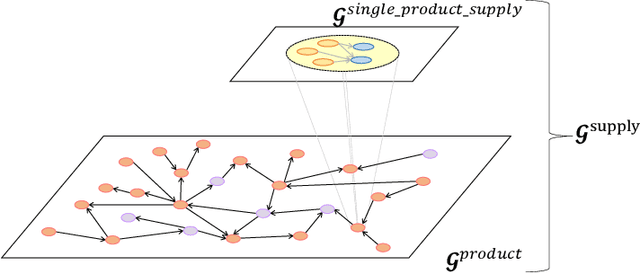
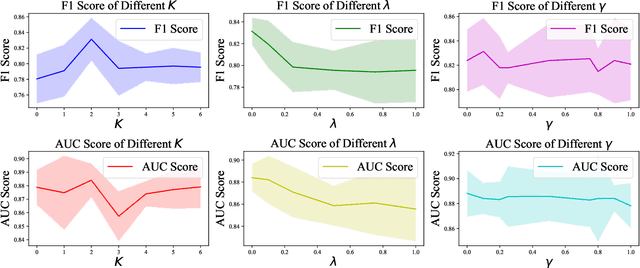

The strength of a supply chain is an important measure of a country's or region's technical advancement and overall competitiveness. Establishing supply chain risk assessment models for effective management and mitigation of potential risks has become increasingly crucial. As the number of businesses grows, the important relationships become more complicated and difficult to measure. This emphasizes the need of extracting relevant information from graph data. Previously, academics mostly employed knowledge inference to increase the visibility of links between nodes in the supply chain. However, they have not solved the data hunger problem of single node feature characteristics. We propose a hierarchical knowledge transferable graph neural network-based (HKTGNN) supply chain risk assessment model to address these issues. Our approach is based on current graph embedding methods for assessing corporate investment risk assessment. We embed the supply chain network corresponding to individual goods in the supply chain using the graph embedding module, resulting in a directed homogeneous graph with just product nodes. This reduces the complicated supply chain network into a basic product network. It addresses difficulties using the domain difference knowledge transferable module based on centrality, which is presented by the premise that supply chain feature characteristics may be biased in the actual world. Meanwhile, the feature complement and message passing will alleviate the data hunger problem, which is driven by domain differences. Our model outperforms in experiments on a real-world supply chain dataset. We will give an equation to prove that our comparative experiment is both effective and fair.